Why do you go to church? Why do you serve on the ministry team? Why do you visit the sick or those in jail? Why do you go on mission trips and sponsor hungry kids? Why do you [...]
The most controversial verse in the most controversial book in the Bible is probably this one: Even so faith, if it has no works, is dead, being by itself. (James 2:17) What [...]
Children and teenagers sometimes hear things that are not true. “If it doesn’t hurt anyone, do it.” “If you don’t get caught, it’s not really wrong.” “If you [...]
I know of a woman who is angry with God. You might think she is angry because she has lost a child or suffered some injustice, but no. Her anger is not based on any [...]
Manmade religion thrives because we are ignorant of God’s word. Religion tells us that repentance means “turn from sin,” so we get busy turning from sin. Religion tells [...]
Many believers know that God has forgiven them, yet they withdraw, self-punish, or strive harder when they fail. They’ve heard about the unconditional love of God, but they [...]
Have you ever noticed how some of the parables of Jesus have strange, uncomfortable endings? Take the parable of the Unforgiving Slave (Matt. 18:23–35). It’s a story [...]
“Am I really okay with God? If God has forgiven me, why do I still feel like I’m on trial? If I’ve been set free, why don’t I feel free?” These are the kinds of [...]
Maybe you are familiar with the parables of the Hidden Treasure and the Pearl. In the first parable, a man uncovers a buried treasure in a field, hides it again, and then [...]
Do you feel condemned even though you know that you are forgiven? Do you feel the pressure to perform even though you know about grace? Do you struggle to reconcile God’s [...]
Few parables have generated as much controversy as the Parable of the Good Samaritan. Jesus told this story to a lawyer who was asking questions about how to inherit eternal [...]
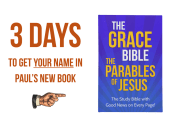
If you have been waiting for a grace-based guide that covers ALL the parables Jesus told, your wait is over. My latest book, The Grace Bible: The Parables of Jesus, has just [...]
We are living in a time of great awakening. All over the world, religious blinders are falling off those who have been kept in bondage. A church dulled by toxic mixture is [...]
The parables of Jesus have twists and turns that can leave you scratching your head. Why does Jesus say “Come as you are” in one parable but “Count the cost” in [...]
Do you sometimes feel that life is so overwhelming and complicated that you don’t know how to pray? Do you worry that your prayers are ineffective and muddled? If you do [...]
Have you ever noticed how often we sing about freedom? “I’m so glad, Jesus set me free.” “My chains fell off, my heart was free…” “Would you be free from the [...]
Just three days left. My new book The Parables of Jesus is coming out soon. This is just a gentle reminder that you have until the end of this week if you would like to get: [...]
Reading the Bible through the lens of grace changes everything. Often I find myself reading familiar scriptures and thinking, “I never saw it this way before” or “Jesus [...]
The Parables of Jesus is the latest, thrilling installment in the Grace Bible series. As far as I know, it is the only grace-based study Bible that covers all of Christ’s [...]
Have you ever noticed how Jesus said his yoke is easy and light, but sermons on his teachings often sound hard and heavy? Something doesn’t add up. Take his parables, for [...]
Why is it that the older you get, the faster time flies? This year went by in a blink. What happened? Quite a bit actually: 250,000 new words were written for the Grace [...]
We who preach grace are sometimes accused of ignoring the Old Testament. But no one could ever make this claim about the Apostle of Grace. In his letter to the Romans, Paul [...]
Here’s the one question I get asked more than any other: “Paul, can you recommend a grace church in (insert small town name I’ve never heard of)?” Usually I can’t [...]
Update: This deal has ended. Subscribe and be the first to know about new deals. For years, readers have been asking, “Paul, why don’t you make your study notes publicly [...]
If Bible verses were medicines, some verses would be wonder drugs. Or maybe miracle cures. Like this one: Therefore there is now no condemnation for those who are in Christ [...]
Do you perform miracles? Do you heal the sick and raise the dead? Because if you’re not, you may not be a real Christian. That’s according to some people. But not me. [...]
Have you ever wondered why some people never respond to the gospel? You tell them God loves them, that he holds nothing against them, and he’s longing to share his life [...]
My scariest movie moment happened at a drive-in theater in 1986. I was in a car with some friends, watching a new release called Aliens. Seen it? We had no idea what the [...]
Israel is again in the news. The endless cycle of violence in the Middle East leaves us wondering, “When will it all end?” So it’s understandable that some take comfort [...]
If Romans is the greatest letter ever written, then chapter 8 is the greatest chapter in the greatest letter. It’s the Everest of Paul’s monumental epistle. In Romans 8, [...]
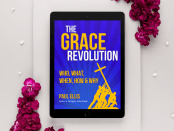
Every day there is more evidence of a worldwide Grace Revolution. Just check out the booming increase in the number of sermons, books, podcasts, and videos about grace. Grace [...]
Does God choose some people to be saved and condemn the rest? Does God harden the hearts of some so they can never come to repentance? You might think so after reading this [...]
The label “Grace Revolution” can be seen everywhere. It’s on churches, ministries, books, and Facebook pages. But what is a Grace Revolution? It will help if we clarify [...]
Over the past few years, many have spoken of a “grace revolution” that is sweeping across the globe. There has certainly been a grace awakening in my own life, but is it [...]
Who told you about grace? Who told them? The message of grace came to you via a long line of preachers and teachers. It began with Jesus and the apostles. Then others passed [...]
You can learn a lot about people by the way they talk. People who have been apprehended by the grace of God talk about Jesus, love, and faith. They use words like [...]
Here’s a question I have for the Jehovah’s Witnesses who knock on my door. “If you believe that only 144,000 people will go to heaven, why are you diminishing your [...]
Sometimes, life knocks you down so hard that you feel like a lowly worm and that the whole world is out to get you. “Everything is against me,” said Jacob after he lost [...]
When Camilla and I took over the pastoring of a church back in 1999, everyone thought it was a good idea – everyone, that is, except me. I thought picking me was a terrible [...]
The three Patriarchs of Israel represent three types of people. Abraham is the believer, Isaac is the fearful, and Jacob? Well, he was the sinner. Don’t get me wrong—I [...]
I have a confession to make. I like gangster movies. Everything I know about organized crime I learned from watching movies like The Godfather, The Untouchables and The Road [...]
I don’t say this enough, but those who preach the good news are the most beautiful people on earth. Just imagine how different your life would be if someone hadn’t told [...]
As a father, I want to give my kids good things—love, food, shelter, opportunities, and memories. But the one thing I want to give them most is a revelation of our heavenly [...]
Some truths have the power to bring healing and hope. Here’s an example: And we know that God causes all things to work together for good to those who love God, to those [...]
Since we have gifts that differ according to the grace given to us, each of us is to exercise them accordingly (Romans 12:6a) We have gifts Every believer has been graced by [...]
Have you been waiting for a study bible that speaks the language of the new covenant? The Grace Bible: Romans is here! With more than 1700 insightful entries, The Grace [...]
Paul’s letter to the Romans is the most quoted, most powerful, and most influential letter ever written. In it, Paul unveils God’s great plan to rescue broken humanity [...]
What can we learn from the fathers of Israel? Is there anything that hasn’t been said about Abraham, Isaac, and Jacob? Over the next few weeks, I will be publishing a short [...]
Peace is a precious gift, yet many people don’t have it. They’re stressed about today, worried about tomorrow, and regretful of the past. Their lack of peace is peace is [...]
Want to know what question I get asked more than any other? “How much does it cost to use the Grace Commentary?” Or “Where can I purchase the Grace Commentary?” For [...]
There are two paths to righteousness. The first path is called Works, and it is the basis of every religion ever invented. The second path is called Grace and it is the [...]
For the past six months I have been writing a book on Romans. At times, I have felt like I was in the house of Gaius listening to Paul dictate his letter. Imagine what that [...]
Should I take this job? Should I move to this city? Should I marry this person? Should I join this church? Should I start a family? Our lives are shaped by the decisions we [...]
Here is the most important paragraph in the most important letter ever written: For I am not ashamed of the gospel, for it is the power of God for salvation to everyone who [...]
We who preach grace like to draw lines between the old and new covenants. We say things like, “In the old covenant, the emphasis was do, do, do, but in the new it is done, [...]
Years ago I heard Joseph Prince say, “God is righteous in making the sinner righteous.” When I heard this, my spirit responded with a hearty “Amen!” But this was one [...]
Imagine you have been asked to pick a verse to display in your church sanctuary. What verse would you pick? Some churches display the Ten Commandments, which is not a good [...]
When I wrote my book encouraging women to speak up in church, I got three types of responses from readers: This is unbiblical – women need to know their place/stay silent, [...]
I enjoy watching marathons and ultras. I love watching runners flog themselves for miles and miles, and I cheer when they cross the line. But recently, I saw something that [...]
Two weeks ago, E2R readers got a free copy of my grace-based commentary on Philemon. If you prefer a printed book, you will be pleased to know that the new book goes on sale [...]
On our local community Facebook page, there was a police notice to beware an armed man who had attacked a local resident. That’s all it said. And judging by the [...]
The book of Philemon may be the most underrated book in the Bible. Like some of Shakespeare’s obscure plays, Philemon is a book people say they’ve read when they [...]
Some people spend more time thinking about their faith than they do about Jesus. They worry they don’t have enough faith or they may lose it. Which is a pity. If they spent [...]
The Bible is a big book. We need help if we are to make sense of it. This is why people write Bible commentaries and study Bibles. Commentaries and study Bibles illuminate [...]
Have you ever noticed how the older you get, the harder it is to run? I used to run 10ks and half-marathons. I once jogged a 50km trail in seven hours. But that was a long [...]
In my last email, I promised E2R subscribers a special Christmas treat. I said I had “a little project” I was working on. Well, I have bad news and good news. The bad [...]
Christmas is the season of giving, so next week I plan to send Escape to Reality subscribers a special gift. It’s a little something I think you will love. (Not a [...]
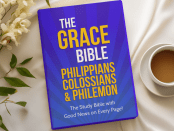
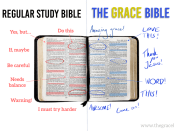
What is the Grace Bible? The Grace Bible is your grace-based, easy-to-read, new covenant study Bible. Unlike other study Bibles that burden you with guilt and leave you [...]
There is a prayer in the Bible that goes right over our heads. Here it is: I pray that the eyes of your heart may be enlightened, so that you will know what is the hope of [...]
“Did James understand grace? Were he and Paul on the same page? Are we saved by faith plus works like he said? Should his book be in the Bible?” People have been asking [...]
You’d be surprised how hard it is to convince some people that God has forgiven all their sins – past, present, and future. “Sure, I believe God loved me enough to send [...]
If there is one book that highlights the dangers of mixing grace with law it’s Galatians. Which is why I am always surprised when people use Galatians to mix grace with [...]
“Why does anyone need a commentary to tell them what the Bible ‘really’ means?” This question was put to me by someone on Facebook. It’s a fair question and it was [...]
The number one reason why we have trouble growing in grace, is we don’t have a teachable heart. “Repent and believe the good news,” said Jesus. That’s not just for [...]
Back when I was a brand new pastor, there was one kind of phone call I got more than any other. “Hi Paul, do you have the number for John (or Jane or Joe)?” I thought [...]
Ever broken a promise, failed to keep your word, or been late for an engagement? Of course you have. Now you know why many Christians are worried sick that they may [...]
When I read a book in the Bible, I like to list my favorite verses and words in that book. As you may know, I spent much of the past year diving deep into Ephesians. My [...]
Ephesians may be the most important letter Paul ever wrote. In this epic epistle Paul covers the full sweep of God’s plan to rescue you, restore creation, and reunite [...]
I have visited hundreds of churches, and I have discovered that some churches may have “grace” in their name, but not in their DNA. They don’t provide what they’re [...]
The “check engine” light had been showing on my dashboard, so last week I took my car in to get checked by the mechanic. Turns out my car has been running lean. Too much [...]
Back in the 1980s, I smuggled Bibles into China. I can remember the tears of joy that Chinese believers shed had when they received their first Bibles. Until they got a [...]
If you are worried about losing your salvation, here’s a question: When you were born again, did you do it? Did you remake or re-create yourself? Did you somehow join [...]
When you see the law mentioned in the Bible, what comes to mind? Perhaps you think “the law” = the Law of Moses. If so, you may dismiss chunks of the New Testament as [...]
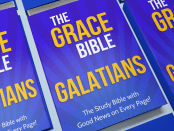
The latest installment in the Grace Bible series has just been released. It’s called The Grace Bible: Galatians and you can get it on Amazon. Why do we need another book on [...]
Are the Gentiles under the law? Were the Gentiles ever under the law? Your answers to these questions depend on how you define “the law.” My answers to these questions [...]
When I visit church websites one of the first things I look at is their sermon index. I want to see what is being preached. Do they preach the good news of Jesus? Or do they [...]
The story of my life: I made a plan and God laughed. Because I am a pastor’s kid, many assumed I would become a pastor. “Not me. No way. No how.” Then I became a [...]
Galatians is a small but precious epistle. It is full of treasures. It has 149 verses and in my forthcoming book, The Grace Bible: Galatians, I unpack every one of them. [...]
Did you know you have been chosen by God to bear fruit? Jesus said: You did not choose me, but I chose you and appointed you so that you might go and bear fruit – fruit [...]
“God is not mad at you, he’s mad about you.” “Oh, yeah? What about the rebukes of Revelation? How does that fit your lovey-dovey grace theology?” Tell people that [...]
We all stumble from time to time. We all make mistakes. Even you. Even though you are 100% righteous and holy in Christ, your behavior is not 100% righteous and holy. From [...]
Do you know how to stay free? We stay free by testing everything. We test the spirits to see whether they are from God (1 John 4:1). We test teachings to see if they align [...]
List all the verses that scare people and this one would be near the top: “If we deny him, he will deny us” (2 Tim. 2:12). Having been raised on a diet of Chick Tracts, I [...]
My dad was a pastor and when he passed away I inherited all his books, Bibles and commentaries. When I became a pastor, I bought more Bibles and commentaries. I have quite [...]
Every Bible teaching, sermon or message you have ever heard has been one of three kinds: law-based, grace-based, or a mixture of grace and law. A law-based interpretation [...]
Are you familiar with Biblical covenants? Reading the Bible without understanding covenant is like going to a medicine cabinet when you are ill and swallowing whatever pills [...]
Imagine going through 12 years of school and never being taught how to read or write. Your teachers taught you maths, music and physical education, but they neglected to [...]
Saint, you don’t have a sinful nature. The old sinner you used to be has been crucified with Christ. One with the Lord you have his heart, his desires, his spiritual DNA, [...]












































































 Escape to Reality