
Paul’s Five Trips to Jerusalem
What five dangerous trips reveal about James, grace, and the early church

Before I was married, I went to Denmark five times in a single year. These weren’t small trips either. Each one involved two flights across two continents. I must’ve had a good reason for going. I did. Her name was Camilla and she’s now my wife.
Did you know the Apostle Paul made five trips to Jerusalem? I’m talking about trips he made after he became a Christian and when he was no longer welcome in the city. The Christians didn’t welcome him at first, and the Jews didn’t welcome him at all—not after he started telling people that he had met the risen Lord.
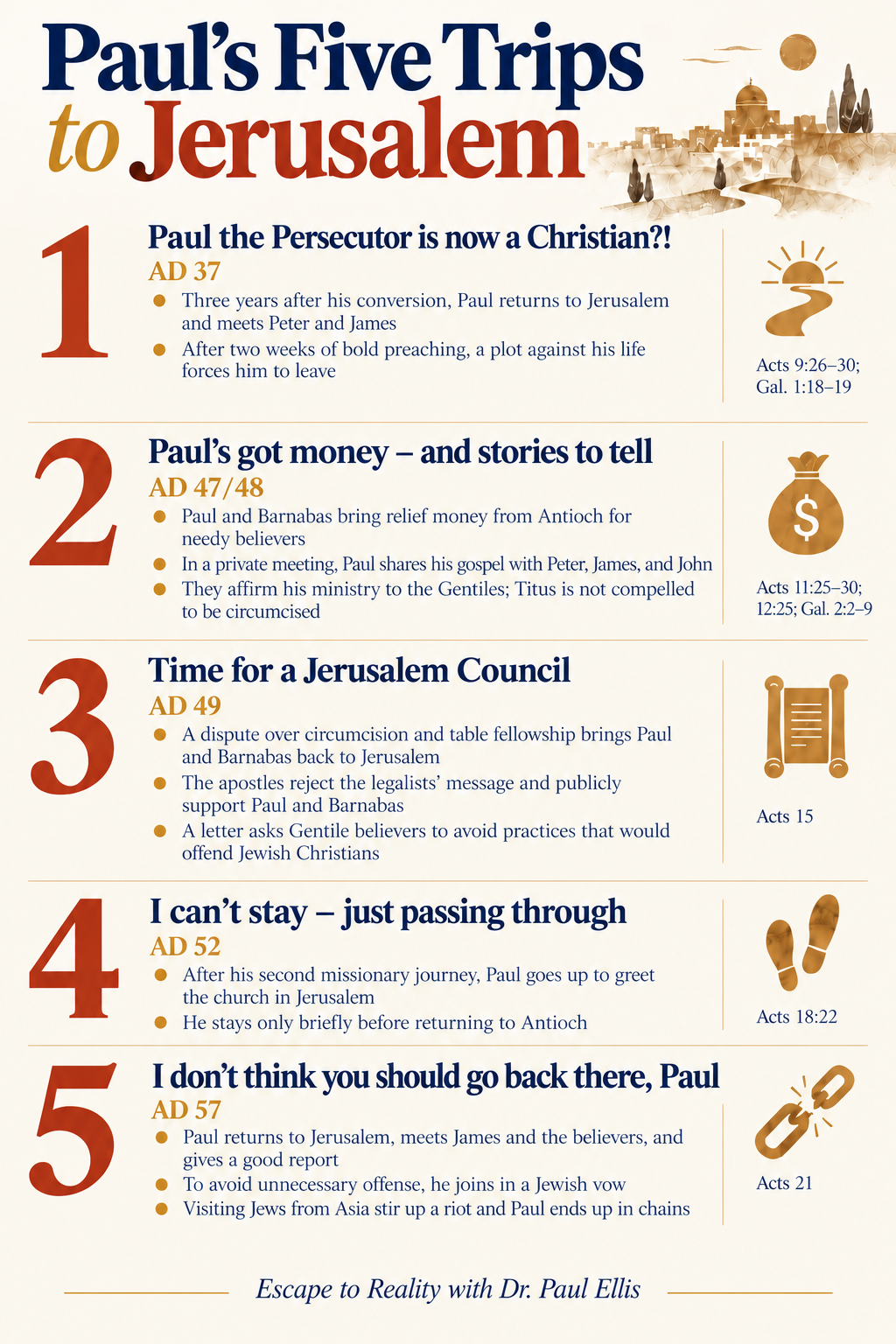
Here is a summary of his five trips to Jerusalem along with my best guesses for the dates.
Trip 1: “Paul the Persecutor is now a Christian?!” (AD 37)
Three years after his conversion, Paul returned to Jerusalem a different man. “I met Jesus on the road to Damascus.” Problem was, nobody believed him. But Barnabas did. He took Paul and introduced him to Peter and James, the Lord’s brother.
For two weeks, Paul went about the city preaching like a firebrand. “Jesus is alive!” Then some Greek-speaking Jews decided to kill him and he left town.
(Sources: Acts 9:26–30, Gal. 1:18–19.)
Trip 2: “Paul’s got money – and stories to tell” (AD 47/48)
On his second trip to Jerusalem, Paul and Barnabas brought money from Antioch to alleviate the suffering of needy Christians.
While in Jerusalem, Paul had a closed-door meeting with Peter, James, and John where he shared his understanding of the gospel that he had been preaching to the Gentiles. This was not the first time Peter and James had heard the gospel from Paul (see Trip #1). But this may have been the first time they heard about his ministry to the Gentiles.
Paul later recalled that he had asked for a meeting “for fear that I might be running, or had run, in vain.” Certain people had been telling the Gentile believers they needed to be circumcised. Paul needed to know if this message was coming from the leaders in Jerusalem. It wasn’t. “Not even Titus was compelled to be circumcised.”
(Sources: Acts 11:25–30, 12:25, Gal. 2:2–9)
Trip 3: “Time for a Jerusalem Council” (AD49)
After a trip to southern Galatia, Paul returned to Antioch to learn that “certain men from James” were creating divisions between the Jewish and Gentile believers. Paul had encountered circumcisers before, but this time the issue was Table Fellowship.
Paul went ballistic and it was decided that he and Barnabas should return to Jerusalem. The issue of circumcision and law-keeping needed to be settled once and for all. On one side were believers from the Pharisees who insisted that Gentile believers must keep the law. On the other side were Paul, Barnabas, Peter, and James.
Since the circumcisers were telling people “James sent us,” James and the others wrote a letter distancing themselves from the legalists and endorsing “our beloved friends Paul and Barnabas.” When the letter reached Antioch, the Christians rejoiced.
The letter also asked Gentile believers to avoid practices that would offend or compromise fellowship with their Jewish brothers and sisters.
Source: Acts 15
Trip 4: “I can’t stay – just passing through” (AD52)
After completing his second missionary trip, Paul landed back at Caesarea. Then “he went up and greeted the church”—almost certainly in Jerusalem—before heading home to Antioch.
Source: Acts 18:22
Trip 5: “I don’t think you should go back there, Paul” (AD57)
After completing another missionary trip, Paul returned to Jerusalem a fifth time. He brought a good report of his travels and James and the believers praised God. “But there is a problem,” said James. “Many of the Jews have heard that you’re telling Jews to disregard Jewish customs. When they hear you’re in town, there will be a riot.”
Not wanting to create trouble for the church or offend his Jewish brothers, Paul undertook a ceremonial Jewish vow. This was consistent with his goal to become all things to all men in order to win some for the Lord. “To the Jews I became as a Jew… though not being myself under the Law, so that I might win those who are under the Law” (1 Cor. 9:20).
It was a good plan and it worked… for about a week. Then visiting Jews from the province of Asia got excited over nothing and Paul ended up in chains.
(Source: Acts 21)
Five journeys that reveal unity, not conflict
All told, Paul visited Jerusalem at least five times over a period of 20 years, from the beginning of his ministry until his arrest and deportment to Rome. On each occasion, he met with James and other believers.
From this we can draw several conclusions:
- Paul and James had a long-standing relationship.
- James was well-acquainted with Paul’s message and ministry. Indeed, he was one of the first people to hear it and he heard it again and again.
- James did not preside over the Jerusalem Council like a Judge Judy. Along with Peter, he was a staunch supporter of Paul and had been so for several years.
- Paul never disagreed with James.
It is sometimes said that James was unfamiliar with Paul’s message or that he didn’t really understand it. Scripture refutes this myth. It is also said that James preached law or mixture, but again, there is no evidence to support this.
James and Paul were partners in grace. Both had life-changing encounters with the risen Lord and both were martyred for their faith.
The main difference between them is that one preached to pagan Gentiles, while the other lived among religious Jews. One traveled the world; the other stayed home.
Different audiences meant different challenges and different ways of preaching the gospel. But both Paul and James were committed to the message of grace and both believed in a church that welcomed Jews and Gentiles.
I went to Denmark five times in a year because there was someone special I wanted to see. Paul did not go to Jerusalem for the food and it wasn’t his home town. For Paul, Jerusalem was the most dangerous city on earth. So why did he go again and again?
He went for the people. And he went to see his friend James.
—
Further reading:
- What did James say about grace?
- Was James writing to saints, sinners, or both?
- What does James say about the new creation?
- What does James say about the grace of God?
- What does James say about intimacy with God?
- What does James say about unconditional forgiveness?
- What does James say about worthless religion?
- What does James say about the prayers of the righteous?
- What does James say about receiving the crown of life?
- What does James say about the rich?
- What does James say about being a “doer” of the word?
- What does James say about the glorious Lord Jesus?
- What does James say about the faith of demons?
- Why does James quote the Ten Commandments?
- What does James say the Law of Liberty?
- Why did James tell Paul the Jews were zealous for the law?
You can also read my entire verse-by-verse commentary on James on the Grace Commentary. It’s free!


Leave a Reply